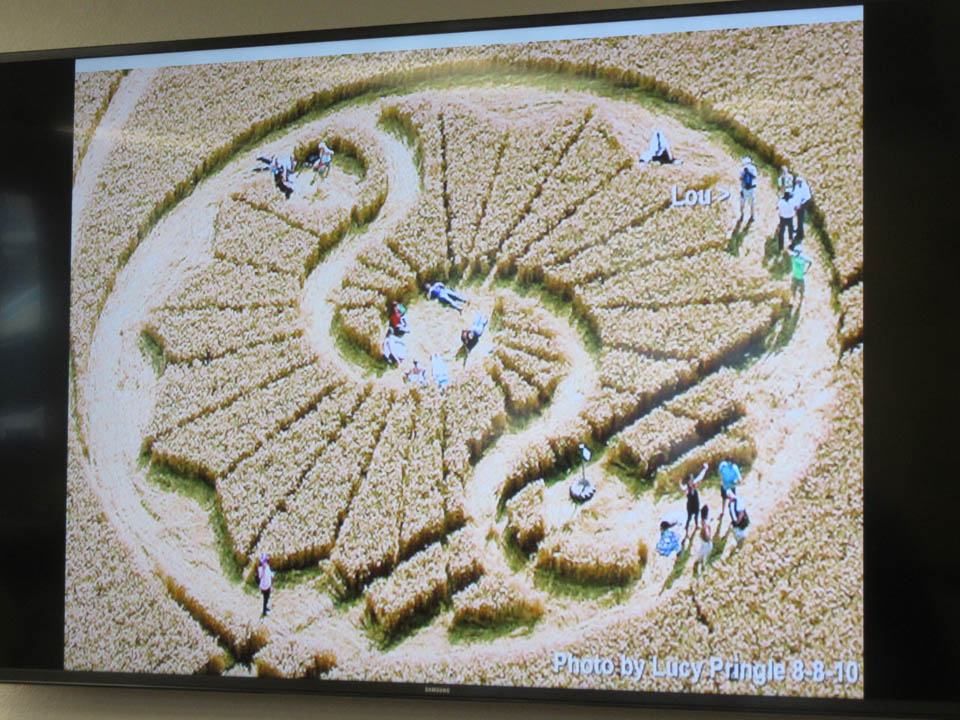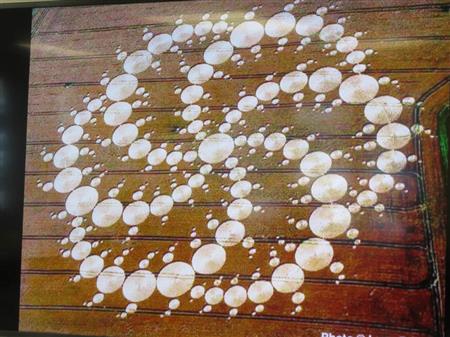
Lou Greub, agronomist and UWRF professor emeritus, summarized some of his research, observations, and travel experiences investigating these phenomena. Crop circles are designs that appear mainly in field crops – wheat, barley, etc., though some designs appear in materials such as sand.
The designs appear when crops lie down on the ground to form a pattern, and many are intricate and not simply circular. They appear more in England than in other countries; 80% are in England, with the greatest concentration in counties south and west of London near Stonehenge; but they have appeared in a total of 44 countries. More than 10,000 have been documented worldwide. . Circles have appeared near our area: MN 15 starting in 1909, WI 23, Iowa 34, IL 23, MI 26. Lou showed a slide of a 17th-century woodcut that appears to depict a crop circle in a field.
Lou’s interest started from his career as an agronomist. His interest is in how they are made; some people look for meaning in the patterns or claim that they derive energy when they are within circles. In 2010, Lou visited England on a tour that visited 8 sites near London and included Stonehenge. 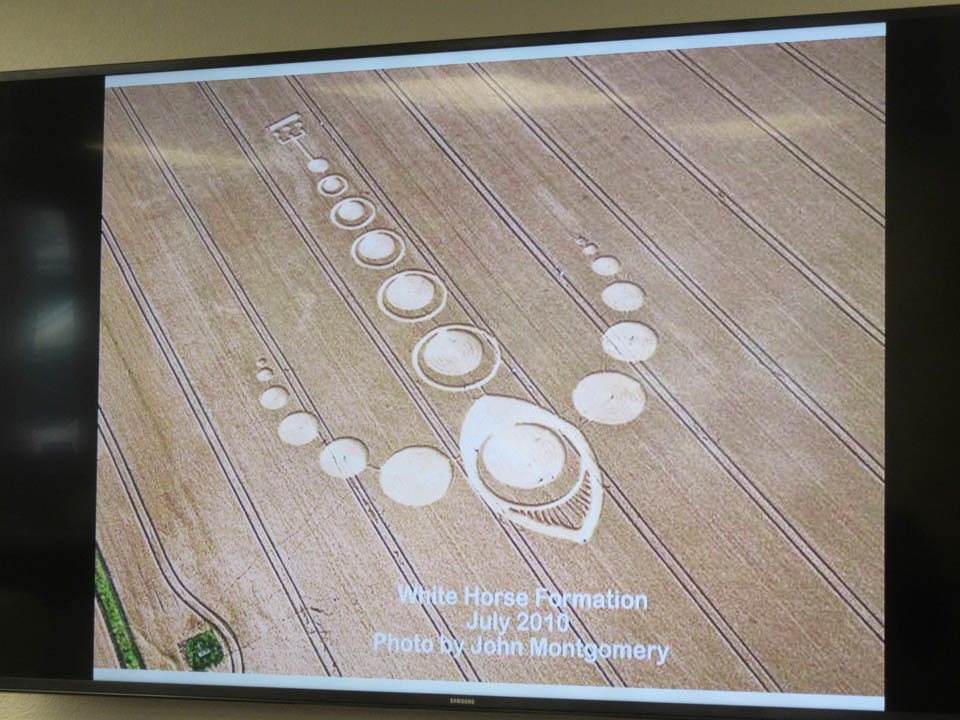
The reactions from farmers vary: some feel honored, most tolerate their presence, and a few hate them and destroy them ASAP or deny access to visitors. Some farmers tolerate visitors and put out collection boxes that help to compensate for lost harvest.
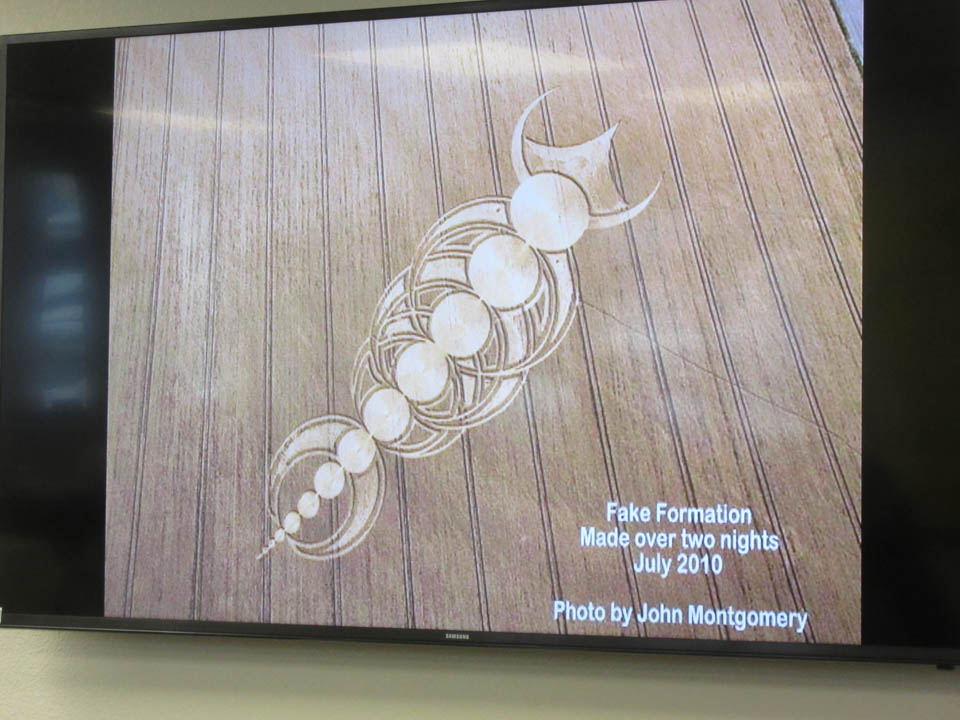
While there have been some fakes, the actual formations appear without evidence of human activity. They usually form at night, but sometimes in daytime. Eyewitnesses have reported flashes of light, balls of light, and occasionally a haze or fog over the area. Research findings, mainly by a private group by three scientists, do not reach a conclusion on a cause or identify a mechanism for the formations of the designs.
Numerous images of crop circles are visible on the internet. Lou also showed us some of the books on the subject.
About the speaker
Lou is a native of Wisconsin who grew up on a small dairy and general farm near Humbird. He is a BS graduate of UWRF, and he earned Masters and Ph.D. degrees at Iowa State University. He served as an agronomist on the Faculty of the UW-River Falls in the College of Agriculture, Food, and Environmental Sciences for 31 years, retiring in 1999.