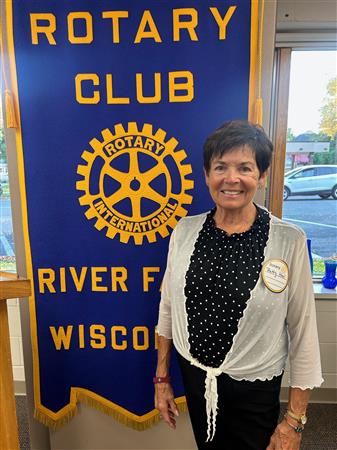
Patty Hall, international team leader for White Bear Lake Rotary, started by acknowledging the River Falls club's contribution to support the project. She noted the generosity of D5960 clubs in supporting district grants. Sixteen clubs from across the district contributed to this particular project, which has major benefits in leveraging WBL Rotary funds.
The purpose of this project is to support 3 schools in Uganda by adding access to clean water and by providing tools and training about sanitation. There is a law in Uganda that schools can’t open without having sanitation in order to minimize the spread of water-borne diseases.
A borehole pump to provide clean underground water and sanitation training are both essential to sustaining the improvement. These two components have many ramifications for an improved society.
Ms. Hall noted that sustainability is key for all projects. Contractors and NGO's, as well as volunteers, must involve the community, engaging in the work and providing the necessary training. For this project, WBL works with a highly-respected NGO called “Drop in the Bucket”. They have a a strong track record of successful projects. The organization is committed to staying in Uganda and providing follow-up, problem solving, and expertise. DITB also provides training to maximize sustainability.
Without access to good water, people have to travel – usually walk – long distances to fetch water.
Without a source of clean water, the risk of water-borne illness increases significantly.
Hygiene training is essential to improve health of the community. School teams are elected to take charge of routine cleaning and maintenance. Supporting 3 schools means supporting about 800 students. Wells provide water to local communities affecting a minimum of 3000 people. Getting students to secondary school has many societal benefits. Educating women often has more local benefit because women are less likely to need to leave the local
community to find work.
The cost of the project was about $24,000 total for the 3 schools. Work was done by local contractors. The NGO does a lot of up-front work with the community to assure buy-in and maximize the sustainability of the project.