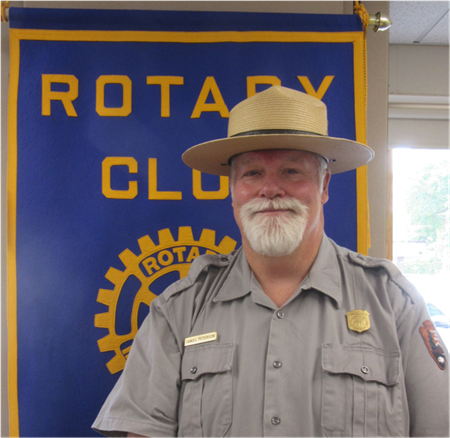
National Park Service Rangers are protectors, preservationists, archeologists, administrators, biologists, and educators. As education rangers, they excel at fostering curiosity and providing educational opportunities to interpret our nation’s special places and stories. Dan Peterson shared with us his role as an education ranger at the St. Croix National Scenic Riverway which is a unit of our National Park System. Dan emphasized the collaborative nature of the St Croix Waterway, which includes state parks in both Wisconsin and Minnesota as well as the NPS. Dan mentioned community Groups such as Wild Rivers and Rivers Alive as valuable resources to expand the educational and conservation work of Dan and his fellow rangers.
The outreach area for the Outdoor Education Rangers for the St. Croix National Scenic Riverway is about the size of New Jersey. The Education Outreach Rangers work with kids and adults. Dan said that his favorite age group is kindergarten to 5th grade because of their openness and curiosity. One favorite activity is “mucking”, which involves using nets to pick up mud from the bottom of the river and identify animals and plants brought up in the net. Dan showed examples of other outdoor education activities including birding along the river, snowshoe hikes, canoeing, and teacher workshops.
There are 63 national parks, which are congressionally designated protected areas operated by the National Park Service, an agency of the Department of the Interior. The national parks are in 30 states and 2 territories. Some of these national parks are sections of a riverway. For instance, the St. Croix National Scenic Riverway is 252 miles along the St. Croix River. The park land is about ¼ mile along both sides of the river. That park riverway has 42 species of freshwater mussels, which is the largest variety in the nation. There are 60 free river access points in the park. The St. Croix River’s Visitors Center is in Taylors Falls.
Park Rangers have a distinctive uniform which includes a distinctive hat called a “flat hat” and is a symbol of authority. Yellowstone was established in 1872 as the first national park, and the government first protected that territory using the military. The hat the Rangers use was adopted from the campaign hat worn by the cavalry troopers. Before the Stetson hat company was contracted to make hats for the Rangers, the Rangers had to shape the top of the hat themselves by manually putting four small dents in the top of the hat themselves.
About Dan: Over the course of his 25-year career, Dan has paddled his career along several scenic roads including the World Bird Sanctuary in Missouri and for the U.S. Fish and Wildlife Service as a Wildlife Refuge Specialist in Arizona and Visitor Services Specialist in Wisconsin. Dan has also worked for the National Park Service at Grand Canyon, Badlands, Crater Lake, Voyageurs National Parks, and Missouri National Recreational River located along the state borders of Nebraska and South Dakota. He’s an avid birder, hiker, and paddler residing in River Falls with his family.