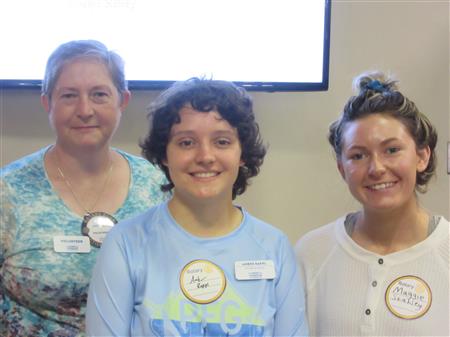
Amber Rappl, Maggie Stahley, and Judie Babcock provided an update on the Kinni Corridor Collaborative sponsored work monitoring stream quality and non-game wildlife populations along the Kinnickinnic River. Amber Rappl and Maggie Stahley are paid interns with the Kinni Corridor Collaborative. The Kinni Corridor Collaborative (KinniCC) is a community-led, non-profit organization working with the city and other stakeholders to implement the Kinnickinnic River Corridor Plan (KRCP).
Their work focuses on the River Water Quality monitoring plan adopted and implemented by the joint efforts of Kiap-TU-Wish, UWRF, and KinniCC. Maggie has connected with other volunteer organizations monitoring non-game wildlife in the Kinni watershed, and she told us about recent birding and pollinator events as examples. The non-game species she monitors include snakes, birds, frog and toads, salamanders, turtles, small mammals, and pollinators.
Amber monitors the water quality by measuring pH, temperature, alkalinity, hardness, nitrates (NO3), nitrites (NO2), turbidity, phosphorus and environmental conditions such as fish kill, algal bloom, and pipe/drain outflow.
[Click Read More for additional detail, including speaker bio's]
The Kinnickinnic River is a class 1 trout stream and an Outstanding Resource Water according to the Wisconsin DNR. It supports naturally reproducing brook and brown trout. It is a spring fed cold water system 22 miles in length with over 8,000 trout per mile in some places.
The purpose of this work is to protect native biodiversity, ensure that people have the resources and information to succeed, promote evidence-based practices, and ensure that the water is safe to drink.
They have learned that the health of the river changes over time in contrast with short-term variations. Monitoring also establishes base-line conditions prior to restoration, i.e. removal of the dams. This information may also help mitigate the impact of development in the future.
August 5-13 is Stormwater Week. Stormwater carries pollutants such as fertilizers, grass clippings, soil, pet waste, oil leaves and trash into local water bodies. For additional information go to www.wistormwater.com.
More resources include the KCC website: kinnicc.org, Leave No Trace website: https://Int.org. Soil Web, iNaturalist, eBird, Wise H2O and St. Croix Valley Bird Club.
About the speakers (in their own words):
My name is Amber Rappl (she/they). I am a student at UW-River Falls working towards a double major in Biology and Biotechnology with a Chemistry minor. I am also the president of the UWRF Bee Club. Last summer I worked with Kinni Corridor Collaborative as a Stream Monitoring Specialist primarily in community education and water quality monitoring. This summer I returned as a Stream Team Lead, and am loving every minute of it! When I'm not doing fun projects with Kinni Corridor Collaborative I also work part-time at the UW-River Falls Sustainability Office. In my free time, I enjoy hiking, kayaking, caving, and overall being outdoors. My favorite hiking trip so far was backpacking the Porcupine Mountains in Northern Michigan.
My name is Maggie Stahley. I graduated with a Bachelor’s degree in Biology and a minor in Spanish from the University of Minnesota Duluth. I work for the Kinni Corridor Collaborative as a Riparian Ecologist to come up with a standard protocol to monitor and survey the riparian zone and non-game species before and after the dam removal. I also do monthly water quality monitoring and outreach events. My favorite part of the job is spending time on the river and being able to meet and network with various groups like Trout Unlimited and Pheasants Forever. I spend my free time trout fishing, hunting, surfing, scuba diving or hanging out with my pug.