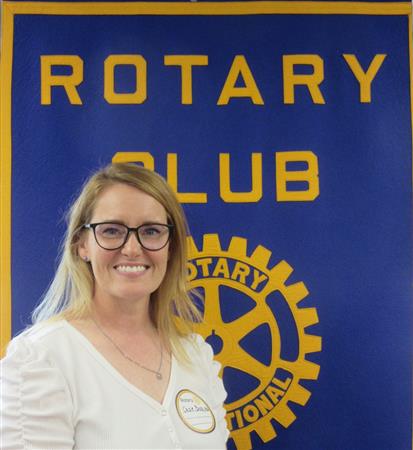
Casie Bass from the UWRF faculty provided the club with an overview of the equine science program. The Equine Program is an undergraduate program with 250 students. The University Horse Farm has 100 acres with 60 horses at 1475 Wasson Lane. Casie noted that these large animals are expensive to feed. The farm breeding program has three stallions and nine mares that produce 3 to 11 foals a year. The farm is expecing 9 foals this spring, with six coming in February. Dr. Bass also described the specialties of the three other faculty members in the department.
What do students do with a degree in equine science? The horse industry is a $120 billion industry in the United States alone. Students do “hands-on” learning with riding, farrier skills (horse shoeing), labs and injections, and other medical treatments. The undergraduates also participate in research studies. Students who graduate from this program go into veterinary medicine, colt training, horse nutrition, barn management, and other horse related careers as well as branching out into other fields. The hands-on learning and research experiences enhance their competitive advantage in securing jobs in the field.
Casie told us that students breed the mares as part of the breeding program. When the foals are two years old the students train the colt for 90 to 100 days, and then the colt is sold at auction on the first Saturday in May. The highest price paid last year for a colt was $20,000.
The university also has a Rodeo Club which supports the Rodeo Team that performs in the university’s annual rodeo. Many colleges in the mid-west have rodeo teams that compete. Members of the Rodeo Team must own their own horse, which is an expensive prospect. The Rodeo Team members do not have to be an Equine major.
The university also has a Hunt Club which rides with English saddles.
Casie Bass is a tenured faculty member in the Equine Program at UW-River Falls. She has been an equine faculty member at UW-River Falls for eight years. She completed her BS and MS degrees at Southern Illinois University in equine science, with a focus on reproductive physiology. After her MS degree, Casie and her husband moved to Brazil for eight months where she completed reproductive research. They then moved to Fargo, ND where Casie attended North Dakota State University and earned a PhD, again with a focus in equine reproductive physiology.
At UWRF, Casie has taught several different courses within the Animal and Food Science Department, most of the courses focused on horses or reproduction. In addition to teaching, she has completed research with undergraduate students, is the president of Phi Kappa Phi, the advisor for the Association of Women in Agriculture, and runs the UWRF Equine Breeding Program.
During her presentation, Dr. Bass mentioned the fact that UWRF’s horse are “reiners”. This video shows what horses trained as reiners do. https://www.youtube.com/watch?v=iR7F8ZqnyiY
Casie would be happy to answer more questions. You can contact her at casie.bass@uwrf.edu